Arquivo da categoria: Photography

Shoot first, understand it later

Why don’t you read listening to what I was listening when writing? Epic Dubstep Mix 2013

Bold statement in a context of war right? I`m glad in photography we frame, shoot and hang people into walls to immortalize them, not to kill`em.

This weekend I was shooting two themes for a photo challenge: hands and letters. Both of them are pretty simple themes with the clear purpose of developing the expression capability, once the objects are pretty simple and well controlled (it`s not exactly “Passing Boeing 747”). We chose to begin with “hands”. Last time I spoke about style with my cousin Elisa she told me she had the impression that I was afraid to exaggerate. Well, I thought, let`s give it a try. I wanted my “hands” to oppress. I wanted to bring some of the worst in me and, yet, establish a connection with the viewer giving a sexual connotation to the picture. We started shooting right on. My friends (brothers?) Tiago and Ana Paula, once again, came to the rescue and not only made this possible, but also transformed a Saturday night into a nice photo shoot.

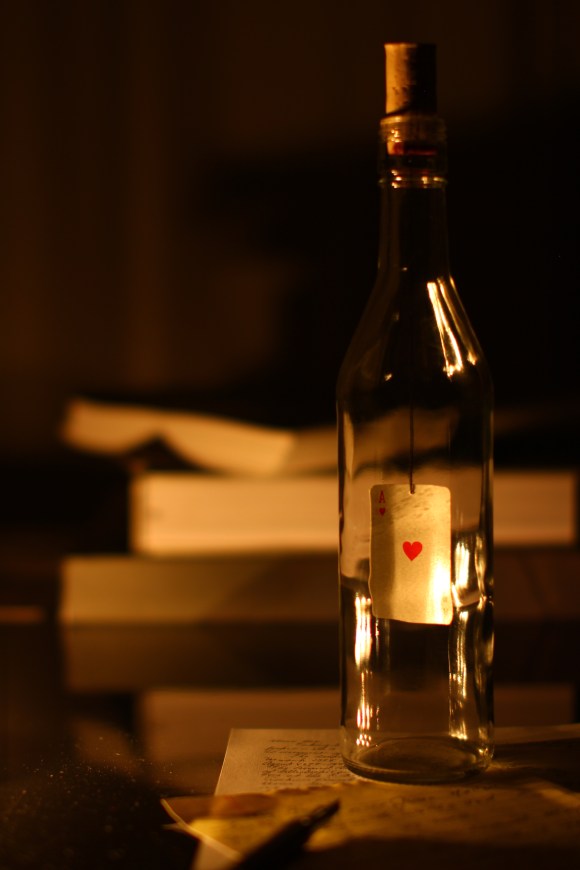
Once satisfied with the results I started shooting the “letters” theme. I came across an image of a heart inside of a bottle and thought about the fact that sometimes we hide our true emotions, even when “corresponding” with people we care. It was already four in the morning when I started the “operation hanging the ace inside the Stolli bottle”. One hour later, the result satisfied me and I went to sleep.

Next day, my friends gave me the feedback: the letters theme was a great success (my wife even wanted it hanging on our wall), and the hands theme rather backfired. That kept me thinking through the weekend: there`s so much more of “me” in the “hands” than in the “letters”, and even so people didn`t connect. I, then, begun trying to understand why I made the picture the way I did. I mean, why was oppression portrayed that way in my head? The answer was not difficult to find. When I was younger, I loved the Soviet Graphic Art. It was strong, bold and with a clear meaning. Try for yourself, and look at these pictures and back to “Domination“:


Once I did a quick research to “remind” my conscious side about the Soviet aesthetics, it all became clear. That’s probably not how people would portray oppression, but it`s clear to me why my brain gave me this path when I disturbed my sleeping unconscious half trying to get something different to print.

Yes, you should follow your subjective side, but that does not mean you should not try to understand it.

:o)
Shower Blues

Shower Blues

Etiquetado ,

Domination

Domination

Etiquetado , ,

Contempt

Contempt

Etiquetado , ,

Unusable Lens and the Mermaid Song


When I started my research to buy a “something wider than 50mm” I came across several options. From Canon, Sigma and Tamron. I really liked the idea of a 28mm f/1.8, but several reviews called it “unusable” on apertures faster than f/2.8 (meaning, the borders of the lens sucked…).

If I can recall, Ansel Adams used lenses made 60 years ago, before all the efforts in lens sharpness and aberration corrections brought by digital sensors had been made. I guess no soul on earth would dare call his pictures “unusable” because of the lens he used. How in the name of large aperture and rounded diaphragm blades would someone call a lens made nowadays “unusable”?

Of course I started searching for image samples and results from resolution, aberration and vigneting tests. The outcome was just as I expected: it`s a great lens, with good resolution on the center and borders. Surely, as every fast lens, the borders are substantially soft when fully opened.

I guess I only realized the real issue after buying and using the Sigma 50mm f/1.4. As I already stated here, the internet “screamed” that this lens had autofocus issues, that it`s results were “unusable” for “serious work”. Well, as I find out, it`s a great lens with focus shift caused by residual spherical aberrations. It had nothing to do with the auto-focus motor or with poor design by Sigma. Canon 50mm f/1.2L, a $1,5K lens, has the same issue (as well as most of the normal-wide fast lens).

I`ve come to realize that the issue is not the equipment, but the folks using it. Thankfully, nowadays, a normal guy like me can buy such a fast glass like the Sigma for under $400, misuse it, and complain all over the internet about how bad it is when focusing, how soft it is wide open, and ultimately, how unusable it`s results are.

The Equipment Mermaid sings to beginners the song of the ultimate photo with the fastest glass. One just need buy it and collect astonishing pictures. The horde of credit card-happy amateurs then buy fast glass (being the most common the Canon 50mm f/1.4, Canon 50mm f/1.2L, Canon 85mm f/1.4L, and mostly anything below f/2.8). Unfortunately, most of them end up frustrated with missed focus pictures and inconstant resolution trough the frame. All that not to mention strong vignette and color bokeh (also known as Transverse Chromatic Aberration) when used fully opened.

From all that, I managed to learn two lessons:

  1. I try to learn as much as I can about my equipment or the kind of equipment I intent to buy. If you want to buy a telephoto lens, learn about it! Search online about the typical strong and weak points of its design and operation. Once I read a review comparing the Canon 600mm f/4 and the Canon 500mm f/4. One costs US$ 12K and the other US$ 10K. By that you can already assume that the choice among them is not based on price. The first one weights 5.4Kg and the second 3.9Kg. There you go. Even the 600mm having a clear advantage in reach, you can probably figure the strain of carrying a 5.4kg lens around all day.
  2. Secondly and most important: read all the reviews you want to, but in the end its paramount to make the choice based on raw test data and pictures taken with the lens. The raw data (MTF graphs, vigneting, distortion tests etc.) enables you to infer the objective quality of the lens. Once you`ve done that, looking at multiple pictures taken with it lets you know if those objective factors translate themselves into images if the subjective character of the lens is pleasing for you.

I`ve learned that lots of websites provide “in depth” reviews of photographic gear. They evaluate the objective factors of the equipment and the look and feel of the lens. From what I`ve learned about photography (and its very little compared to what`s out there) no graph can tell if a lens is capable of making good images and no photography cares if it was shot with a “beautiful all metal body” lens.

Sail Away

Sail Away

Etiquetado , ,

Style or Comfort Zone?


Recently some friends and I started a small photo challenge. As I was organizing it with another friend, we tried to let the trivial themes in the first three photos and then we`d put a theme a bit more complex or requiring a specific technique, like “Order in Chaos”, or “Light Painting”. The first one, as usual in this kind of challenge, was a simple, trivial, self-portrait. First time I did one, I used a large silver spoon to reflect my image in its back and made it a very grainy and high contrast B&W. It was a nice idea that worked just fine! This time, the only thing I could figure out was an eye macro also B&W. Kind of a combination of two things I`ve already done.

Then it struck me.

That`s not about my style. That`s just me being lazy and trying to do things I know are going to work. It`s not that style is not important. It is, a lot. The thing I hear the most about photography (or art as a whole) is that one must develop its own style as soon as possible. I do have, nevertheless, the impression the word “style” is being held captive somewhere and the expression “creative inertia” has taken its place. When I sent the first image, my cousin Elisa (who has taught me a lot, even if she doesn’t fully know it) told me: “you`re already good in the technical part, it`s not about that, it`s about getting out of the comfort zone”.

Elisa was right.

It`s like making the trip backwards, from photography to subjectivity. As I`ve already stated before, I`m not a very creative person. Even tough, I`m still able to differentiate creative style and its inertia. It`s very common in photographers (mainly those who work with some specific kind of photography, like weddings) to learn a technique and then use it like there`s no tomorrow, HDR being the famous one right now.

It is a good sensation to master some kind of photography. The bad thing is that every new picture you make using something you already know it`s one opportunity to learn something new you throw away. The idea is clear to me now: as photography is a hobby to me, I prefer to have a portfolio full of mistakes of different kinds than to have it full of fantastic pictures taken the same way.